

If you have ever opened a jar of shilajit resin during a cold winter morning and found that it is suddenly stiff, thick, or surprisingly difficult to scoop, you may wonder whether something has gone wrong. The behavior can be especially noticeable with natural products marketed as Real Pure Shilajit In UK, because genuine resin can change considerably in consistency as its temperature changes. What happens to the resin in the cold, however, is more interesting than simply saying that it “hardens.”
Why Does Shilajit Turn Hard When Cold?
Shilajit resin can become considerably harder in cold temperatures because cooling increases its viscosity and reduces its ability to flow.
At a warmer room temperature, resin is generally more flexible and easier to manipulate. As the temperature drops, the material becomes progressively more viscous. In practical terms, this means it flows less readily, feels thicker, and may resist a spoon or applicator when you try to take a portion.
This is a normal physical response for many viscous, resinous substances. Temperature affects how easily their molecules and components move relative to one another. When the material is warmer, it tends to become more fluid. When it is colder, movement is reduced and the material becomes more rigid.
That is why shilajit turns hard when cold without necessarily being damaged or spoiled.
The exact texture can vary from one product to another. Shilajit is a naturally complex substance, and the final consistency can be influenced by its composition, processing, concentration, moisture content, and storage conditions. Some resins may become very firm in a cold environment, while others may remain somewhat pliable.
Importantly, a change in texture by itself does not mean that the shilajit has gone bad. A jar that feels soft in a warm room and almost solid in a cold room may simply be responding to its surroundings.
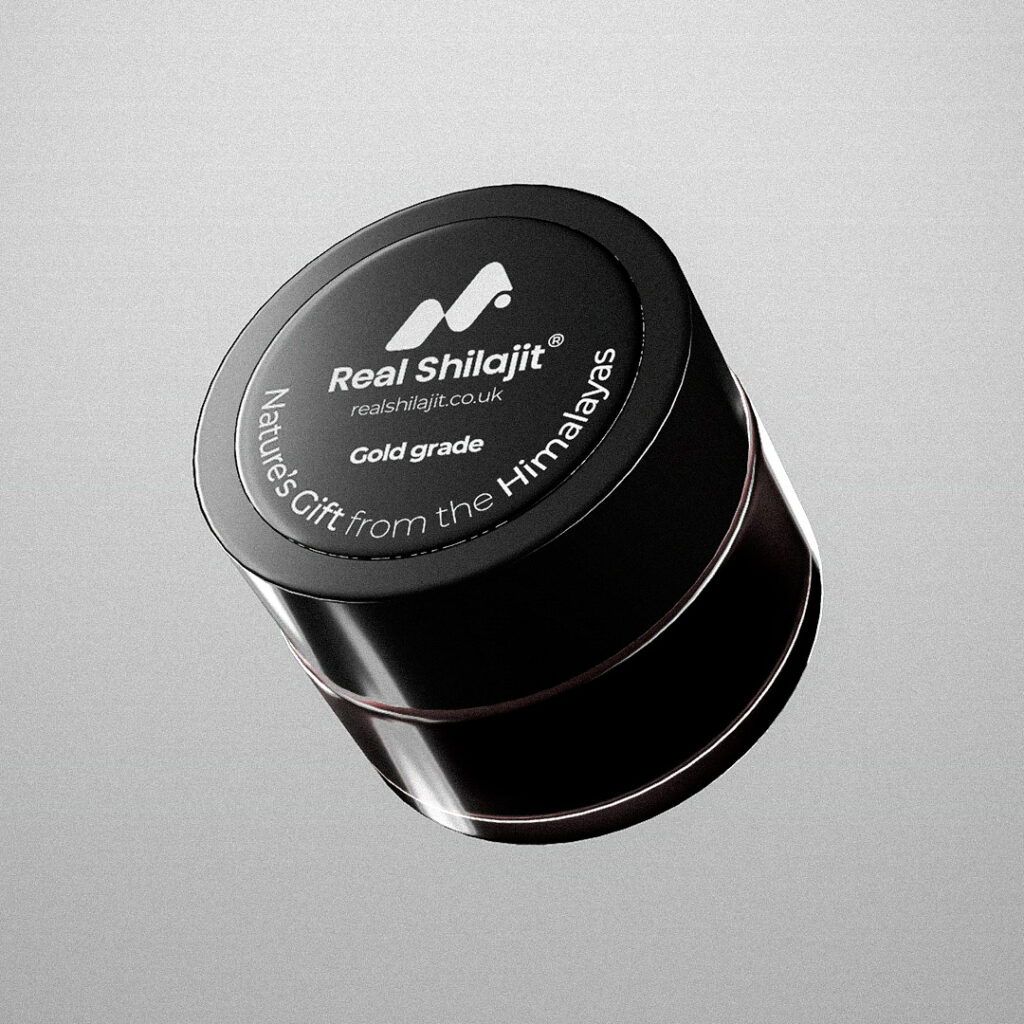
Gold Grade Jar
-
Boosts energy and stamina for intense workouts
-
Supports healthy testosterone levels naturally
-
Enhances muscle recovery and performance
-
Promotes healthy skin and overall vitality
Why Does Shilajit Become Thick or Difficult to Scoop in Winter?
Winter can make a noticeable difference to shilajit resin consistency, particularly if the container is stored somewhere considerably cooler than normal indoor conditions.
If you are asking, “Why is my shilajit hard?”, the first thing to consider is temperature. A resin that was easy to scoop during summer may become thick and resistant during winter simply because the surrounding temperature has fallen.
This is particularly noticeable when a container is kept near a cold window, in an unheated room, in a garage, or somewhere else exposed to low temperatures. The resin itself does not necessarily need to freeze for its texture to change significantly. Even moderate cooling can make a viscous material feel much less workable.
There is also an important distinction between cold weather thickening and deterioration.
Deterioration involves unwanted changes caused by factors such as contamination, unsuitable storage, moisture exposure, or other conditions that affect the product over time. Cold induced thickening, by contrast, is primarily a physical change in consistency.
If the resin returns toward its usual consistency after gradually reaching room temperature, that is consistent with a temperature related texture change.
However, texture should not be considered in isolation. If the product has developed an unusual odor, visible contamination, unexpected discoloration, damaged packaging, or other signs that concern you, it is sensible to check the manufacturer’s guidance rather than assuming the change is caused only by cold.
Does Cold Temperature Change the Texture of Shilajit Resin?
Yes. Temperature can affect several noticeable properties of shilajit resin, including its viscosity, flexibility, stickiness, softness, and ease of portioning.
At a relatively warm room temperature, a resin may be soft enough to collect with a small spoon or applicator. When exposed to colder conditions, the same material may become progressively thicker. Eventually, it may feel stiff enough that trying to scoop it becomes inconvenient.
This does not necessarily mean the underlying product has fundamentally changed. Often, the most obvious difference is its physical behavior.
Think of the difference between a fluid syrup stored in a warm environment and the same syrup after being chilled. The colder material may flow much more slowly even though it remains the same substance. Shilajit resin can show a similar temperature dependent change, although its consistency is naturally much more complex than that of an ordinary syrup.
The phrase “shilajit becomes solid in cold” can therefore be somewhat misleading. Depending on the product and temperature, it may become extremely firm without becoming literally solid in the way that water becomes ice.
The degree of change also matters. A mildly cool environment may simply make the resin thicker, while substantially lower temperatures can make it considerably harder.
Is Hard Shilajit a Sign That It Is Real?
Not by itself.
Hardness is sometimes discussed online as though it were a simple authenticity test: real shilajit supposedly becomes hard in the cold, while fake shilajit supposedly does not. That is far too simplistic.
Hardness alone is not a reliable test of whether shilajit is genuine.
A genuine resin can change consistency with temperature, but that does not mean every hard resin is authentic. Conversely, a product that remains relatively soft does not automatically indicate that it is fake. Formulation, processing, moisture content, concentration, storage conditions, and temperature can all influence physical consistency.
This is particularly important when evaluating pure shilajit resin. Consumers should resist the temptation to use one visible characteristic as proof of purity.
A better assessment considers the broader picture. Where was the material sourced? Is the producer transparent about processing? Is there meaningful information about testing and purity? Can the product be traced to a manufacturer or supplier? Is the packaging appropriate and properly sealed? Are storage instructions provided?
These factors provide considerably more useful information than whether a spoon can easily penetrate the resin on a cold day.
The same principle applies when judging so called authentic shilajit. Physical appearance can provide observations, but it cannot replace appropriate quality control and testing.
How Can You Soften Shilajit Resin Safely?
If your shilajit has become difficult to scoop because of cold weather, the simplest approach is usually to let the container gradually return to room temperature.
Keep the container closed while it warms. This allows the resin to become more workable without introducing unnecessary moisture or contamination.
Depending on the product, this may be enough to restore a softer consistency. You do not necessarily need to apply additional heat.
If gentle warming is appropriate according to the manufacturer’s instructions, avoid exposing the resin directly to a strong heat source. There is little reason to aggressively heat a small container simply to make it easier to scoop.
Avoid placing the jar directly on a hot surface, using a flame, microwaving the resin, or otherwise subjecting it to uncontrolled high temperatures. These methods can expose the product to temperatures far beyond what is necessary for simply returning it to a workable consistency.
A gradual change toward normal room temperature is the conservative option.
If the manufacturer provides specific instructions for handling cold or hardened resin, those instructions should take priority because formulations and packaging can differ.
Gold Grade Jar
-
Boosts energy and stamina for intense workouts
-
Supports healthy testosterone levels naturally
-
Enhances muscle recovery and performance
-
Promotes healthy skin and overall vitality
Does Heat Affect Shilajit Resin?
Heat and cold affect resin in opposite physical directions.
Cold generally increases viscosity and makes shilajit more difficult to manipulate, while warmth tends to reduce viscosity and make it easier to work with.
That does not mean that more heat is better.
There is an important difference between gentle warming and prolonged exposure to unnecessarily high temperatures. A container reaching ordinary room temperature is very different from repeatedly heating the resin to high temperatures.
It is also unnecessary to claim that normal room temperature warming automatically destroys all of shilajit’s beneficial compounds. Such a blanket statement would go beyond what can reasonably be concluded from texture alone.
The sensible approach is to avoid extremes. Store the product according to the manufacturer’s recommendations, avoid unnecessary temperature fluctuations, and do not deliberately expose the resin to intense heat simply because it has become firm.
If a product comes with a defined storage range, that guidance is more useful than applying a generic temperature rule to every type of shilajit.
How Should Shilajit Resin Be Stored in Cold Weather?
Good storage is less about keeping shilajit at one magically perfect temperature and more about maintaining stable, appropriate conditions.
For cold weather storage, consider the following principles:
- Keep the container in a stable indoor environment rather than somewhere exposed to severe cold.
- Avoid unnecessary movement between very cold and very warm environments.
- Keep the container properly sealed when not in use.
- Protect the resin from moisture, dust, and other sources of contamination.
- Follow the manufacturer’s storage instructions whenever they are available.
A stable room temperature environment is generally more convenient if you want the resin to remain easy to portion. If the container has been stored somewhere cold and the resin becomes hard, allowing it to return gradually to normal indoor temperature may restore its usual consistency.
Moisture deserves particular attention. Opening and closing a container repeatedly in unsuitable conditions can introduce contaminants or moisture, depending on the environment and packaging. Keeping the container properly closed helps protect the product regardless of the season.
Storage conditions are also relevant when evaluating changes that seem unusual. If a resin has remained consistently hard because of a cold environment, that is different from a product whose appearance or smell changes unexpectedly after prolonged exposure to unsuitable conditions.
What Does the Texture of High Quality Shilajit Resin Look Like?
There is no single texture that can universally identify high quality shilajit.
Natural resin can vary in consistency depending on temperature, formulation, processing, moisture content, concentration, and storage. One batch may be relatively soft and pliable at room temperature, while another may be noticeably thicker.
Temperature is particularly important when comparing descriptions or photographs online. A product shown in a warm environment may look glossy and soft, while the same product in a colder room may appear significantly firmer.
This is why statements such as “real shilajit must always be soft” or “real shilajit must become completely hard in winter” are unreliable.
The better question is whether the product’s characteristics are consistent with the manufacturer’s description and whether there is credible information supporting its quality.
Texture can be an observation, but it should not be treated as a laboratory test.
What Else Should You Check When Buying Shilajit Resin?
If you want to evaluate a shilajit product properly, look beyond the way it behaves on a cold morning.
Sourcing transparency is an important starting point. A reputable supplier should be able to provide meaningful information about where its raw material comes from rather than relying entirely on vague geographical or traditional claims.
Processing information can also be useful. Consumers should be able to understand, at least in general terms, how the raw material is prepared before being sold as a finished resin.
Testing and purity information deserve particular attention. Where appropriate, independent laboratory testing can provide more meaningful evidence about the contents of a product than visual inspection or texture. Depending on the product and market, relevant testing may address contaminants and other quality parameters.
Traceability is another useful consideration. Clear manufacturer information, batch identification, packaging details, and appropriate documentation make it easier to understand where a product came from and how it is managed.
Packaging matters as well. A properly sealed container helps protect the resin from environmental exposure and contamination. Clear storage instructions are another positive sign because they show that the manufacturer has considered how the product should be handled after purchase.
Ultimately, real shilajit should not be judged by a single trick or visual test. The fact that a resin becomes hard in winter can be completely normal, but it cannot establish authenticity on its own.
Conclusion
When shilajit turns hard when cold, the most straightforward explanation is usually a change in viscosity caused by lower temperature. As the resin cools, it becomes less fluid, less flexible, and more difficult to portion. That can be especially noticeable during winter or when a container is kept in a particularly cold environment.
The important point is that cold induced hardness does not automatically mean the resin has deteriorated, nor does hardness prove that a product is authentic. Texture can tell you something about how the material is behaving, but meaningful quality assessment requires a much broader view.
If your shilajit resin becomes hard, allowing it to gradually return to room temperature is generally the simplest approach. Avoid unnecessary high heat, keep the container sealed, protect it from moisture and contamination, and follow the manufacturer’s storage guidance.
In other words, “Why Does Shilajit Turn Hard When Cold?” is primarily a question of physical behavior, not a simple authenticity test. Understanding that distinction can help you handle your resin properly while making more informed decisions about product quality.
Gold Grade Jar
-
Boosts energy and stamina for intense workouts
-
Supports healthy testosterone levels naturally
-
Enhances muscle recovery and performance
-
Promotes healthy skin and overall vitality